- 1871
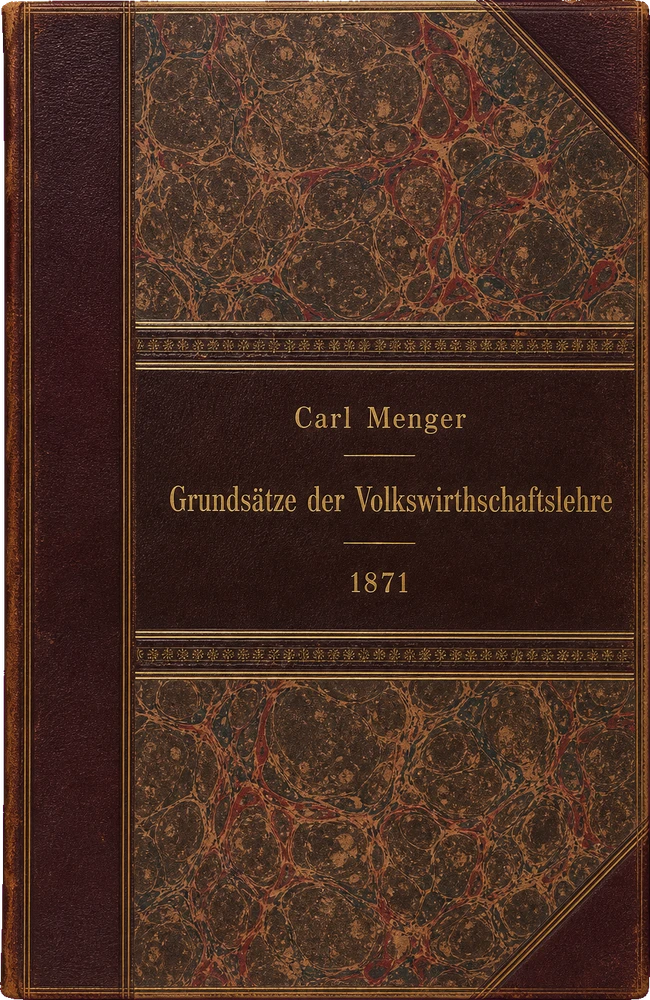
Grundsätze der Volkswirthschaftslehre. Erster, allgemeiner Theil
Carl Menger · 55 sectionsNothing becomes a good, Menger argues, until a human need, knowledge of a thing's power to satisfy it, and command over that thing coincide. From this causal starting point the founding text of the Austrian School rebuilds economics without cost as an independent source of value. Goods of higher order, tools, land, labor, matter only because they help bring about future satisfactions, and value itself is the significance a concrete unit holds for an economizing person, measured by the least important want its loss would leave unmet. This marginal principle, cast as causal explanation rather than mathematics, reverses classical doctrine: the expected value of the product governs the value of its means, not the reverse. The same logic carries through exchange, monopoly and competition, and finally money, which Menger derives from the differing saleability of goods as an unintended institution rather than a creature of law.
Der Werth ist demnach nicht nur seinem Wesen, sondern auch seinem Masse nach subjectiver Natur.
English translation: “Value is therefore subjective in nature not only in its essence but also in its measure.”
- 1883
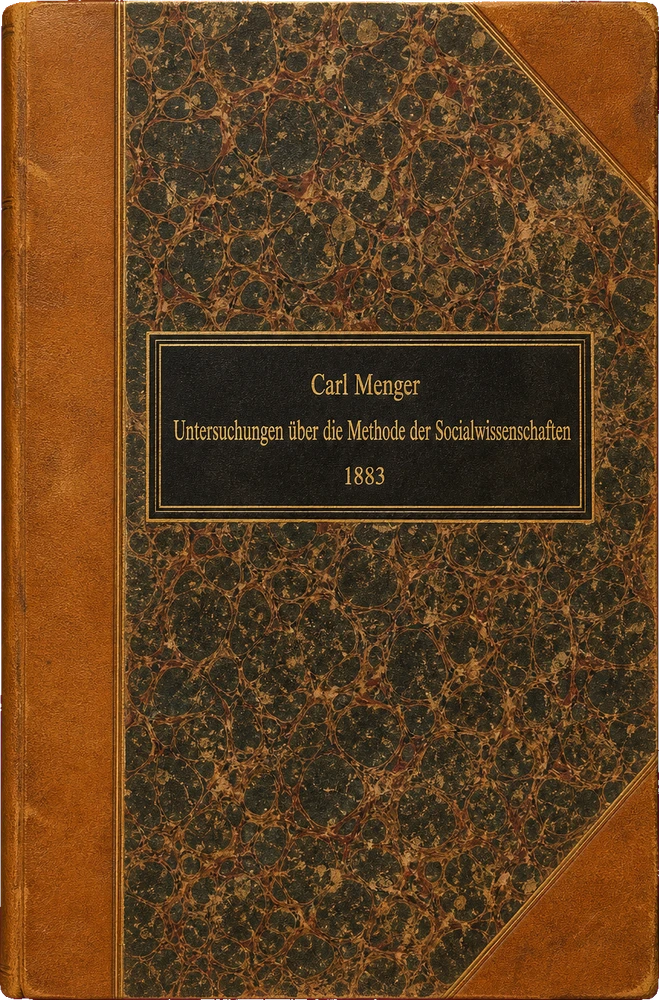
Untersuchungen über die Methode der Socialwissenschaften, und der Politischen Oekonomie insbesondere
Carl Menger · 49 sectionsWhen German economists claimed the historical method could stand in for economic theory, Menger set out to expose the confusion buried in that claim. Opening the Methodenstreit, the Untersuchungen distinguishes three irreducible tasks: historical-statistical inquiry into concrete developments, theoretical inquiry into general types and laws, and practical inquiry into maxims for action, each answering a different question, none reducible to the others. Within theory he separates realistic-empirical research, which takes phenomena in full complexity, from exact research, which isolates their simplest elements to derive strict laws. That same exact orientation grounds his account of spontaneously arising institutions: money, law, language, and markets emerge as the unintended resultant of countless individuals pursuing their own interests, neither natural organisms nor products of collective design. Only in its final books does the polemic name its targets, Roscher, Hildebrand, Knies, whose historicism, Menger charges, mistook material for theory.
Die Probleme der Wissenschaft können solcherart allerdings ausserordentlich vereinfacht werden — indess nur um den Preis des ganzen Erfolges.
English translation: “The problems of science can indeed be extraordinarily simplified in this manner—but only at the price of the entire success.”
- 1873Arrondierung der Landgüter
Arrondierung der Landgüter
Carl Menger (attributed; signed —r.) · 2 sectionsFreedom from feudal dues did not necessarily give farmers freedom to manage their land. In this 1873 review of Karl Peyrer’s study, attributed to Carl Menger and signed “—r.”, scattered plots and overlapping grazing and woodland rights become a test of what voluntary agreement can accomplish. The reviewer argues that private exchanges may prove inadequate, while dividing common land can actually multiply fragmentation. His case for compulsory state action rests on a concrete tension: coordinated intervention may be needed to make independent cultivation possible. Yet consolidation is not treated as an indiscriminate remedy; vineyards and gardens have different requirements from other farmland. The review offers a precise encounter with agrarian reform as a problem of cultivation, property rights, and practical administration rather than legislation alone.
- 1873Das österreichische Bergwesen
Das österreichische Bergwesen
Carl Menger (signed M.) · 1 sectionsHow much detail makes an industrial handbook useful? In this short review, signed “M.,” Carl Menger assesses the Austrian Ministry of Agriculture’s mining and metallurgy volume, edited by A. Schauenstein for the 1873 Vienna World Exhibition. He welcomes its combination of specialist contributions and a common descriptive framework, linking geological deposits and extraction methods with costs, employment, and markets without cataloguing every individual works. His approval has a clear limit: judging the accuracy of each branch’s account belongs to the relevant experts. The review offers a compact glimpse of Menger as a reader of industrial documentation, attentive to the distinction between comprehensive coverage and exhaustive detail, and to the usefulness of technical knowledge beyond professional circles.
- 1873Der Zwiespalt unter den deutschen Volkswirthen
Der Zwiespalt unter den deutschen Volkswirthen
Carl Menger (signed M.) · 2 sectionsDoes freedom of contract suffice to protect workers, or can state regulation help make that freedom effective? In this 1873 newspaper article, signed “M.” and published in two instalments, Carl Menger examines the division between German free traders and ethical economists without accepting either camp’s caricature of the other. Free traders need not be indifferent to hardship; advocates of factory inspection and social reform need not be socialists. Menger shifts attention from intentions to knowledge: which remedies can alleviate distress without making it worse? His comparison exposes the distance between gains to individual traders and welfare shared across society. Readers encounter a carefully qualified account of economic liberalism, in which neither abstract nonintervention nor benevolent reform settles the practical question of what government can accomplish.
- 1873John Stuart Mill
John Stuart Mill
Carl Menger (attributed; printed signature: –r.) · 1 sectionsCan a thinker transform public life without substantially renewing the theoretical foundations of his disciplines? This 1873 review of Mill’s Autobiography, attributed to Carl Menger and signed “–r.”, separates intellectual originality from reforming achievement. Against a continental reputation centred on Mill’s scholarly books, the reviewer emphasizes his sustained challenge to privilege and inherited institutions. The account of his severe childhood education also raises a concrete pedagogical question: should classical languages open access to ideas, or become ends in themselves? Admiration remains qualified throughout. The reviewer treats Mill’s economics as largely Ricardian in foundation yet influential in its reformist applications, offering readers a pointed examination of why scientific innovation, practical usefulness, and public influence need not coincide.
- 1873Nationalökonomie
Nationalökonomie
Carl Menger (signed M.) · 1 sectionsDescribing how materials become consumable goods is not yet explaining production economically. This distinction anchors Carl Menger’s short 1873 review, signed “M.,” of Emanuel Herrmann’s Principien der Wirthschaft. Menger welcomes Herrmann’s attempt to give industrial production the sustained attention political economy has devoted to exchange. Yet he finds that technical detail and analogies with nature too often displace economic analysis. His response also tests the value of originality: independence becomes a limitation when an author scarcely engages existing scholarship. The review offers a compact view of Menger’s critical standards, showing how he can endorse an expansion of economic inquiry while questioning the methods used to pursue it.
- 1873Nationalökonomie
Nationalökonomie
Carl Menger (attributed; signed M.) · 1 sectionsPhysical force may be conserved while economically useful effort is wasted: this distinction sharpens the criticism in “Nationalökonomie,” a brief 1873 review signed M. and attributed to Carl Menger. Reviewing Fr. Xav. Neumann’s economics textbook for military schools, the reviewer challenges its transfer of natural-scientific laws into economic explanation. Neither conservation of force nor Darwinian analogy, he argues, establishes an economic law merely by borrowing scientific authority. Yet this methodological objection does not cancel the book’s educational achievement. Its clarity and attention to military administration earn warm praise. The review offers a compact encounter with two distinct standards of judgement: what makes an economic explanation valid, and what makes a textbook useful.
- 1873Nationalökonomie
Nationalökonomie
Carl Menger (attributed; signed M.) · 1 sectionsHow could a gold rush that drove up labour costs also help sustain Australia’s wool exports? This 1873 review, signed “M.” and attributed to Carl Menger, draws on Cairnes’s Essays in Political Economy to explain the unexpected connection. Gold mining pulled workers away from pastoral employment, but the growing mining population also paid more for meat, helping livestock breeders absorb costs they could not pass on to international wool buyers. Addressing the concerns of Austrian breeders and manufacturers, the reviewer traces how demand for one product could support another produced by the same enterprise. The resulting forecast remains conditional: domestic meat consumption might limit Australian wool competition, while preserved-meat exports could give it fresh momentum.
- 1873Neuere Fortschritte in der Wetterkunde
Neuere Fortschritte in der Wetterkunde
Carl Menger (bibliographic attribution; signed —r.) · 5 sectionsA long spell of rain need not mean that sunshine is due: this 1873 scientific review makes weather’s tendency to persist a challenge to everyday expectations. Bibliographically attributed to Carl Menger and signed “—r.”, it assesses meteorological research reported by R. Scott, asking how forecasting can become useful before it becomes exact. Its distinctive concern is the distance between an observed regularity and a timely basis for action. Weather lore survives forgotten failures; statistical forecasts must instead reckon with uncertainty and the limits of observation. Through concrete examples involving rainfall, temperature and storm warnings, the review shows why probabilistic knowledge can matter to farmers, navigators and grain traders without warranting confident predictions of particular events.
- 1873Zeitschrift für privates und öffentliches Recht der Gegenwart
Zeitschrift für privates und öffentliches Recht der Gegenwart
Carl Menger (attributed; signed M.) · 1 sectionsWhat should a legal journal include when legislation is continually changing? This 1873 notice, signed “M.” and attributed to Carl Menger, welcomes Professor Grünhut’s new journal as a meeting point for Austrian legal scholarship and public discussion of reform. Its interest lies in the editorial boundary it endorses: the quoted prospectus makes contemporary law the priority without dispensing with philosophical reflection or historical explanations of living institutions. The reviewer values the journal’s practical purpose, university backing, and attention to foreign legal systems. This brief notice offers a concrete glimpse of the expectations attached to a new scholarly forum: to bring learned jurists into legislative debate while connecting domestic legal practice with comparative inquiry.
- 1873Zur Goldfrage
Zur Goldfrage
Carl Menger (signed M.) · 3 sectionsMore gold need not make money work better—but can it still make people wealthier? In this 1873 review of J. C. Cairnes’s Essays in Political Economy, Carl Menger distinguishes gold’s monetary function from its uses in jewellery, utensils, and ornament. Depreciation may offset an increase in the monetary stock without cancelling the benefit of wider access to a desirable material, even when vanity shapes demand. Yet Menger’s disagreement does not prevent him from praising Cairnes’s explanation of silver flowing toward India and East Asia: expanding monetary exchange, rather than hoarding alone, helps account for its absorption. The review offers a compact encounter with Menger’s attention to concrete uses—and with his ability to separate a disputed premise from a persuasive explanation.