- 1889
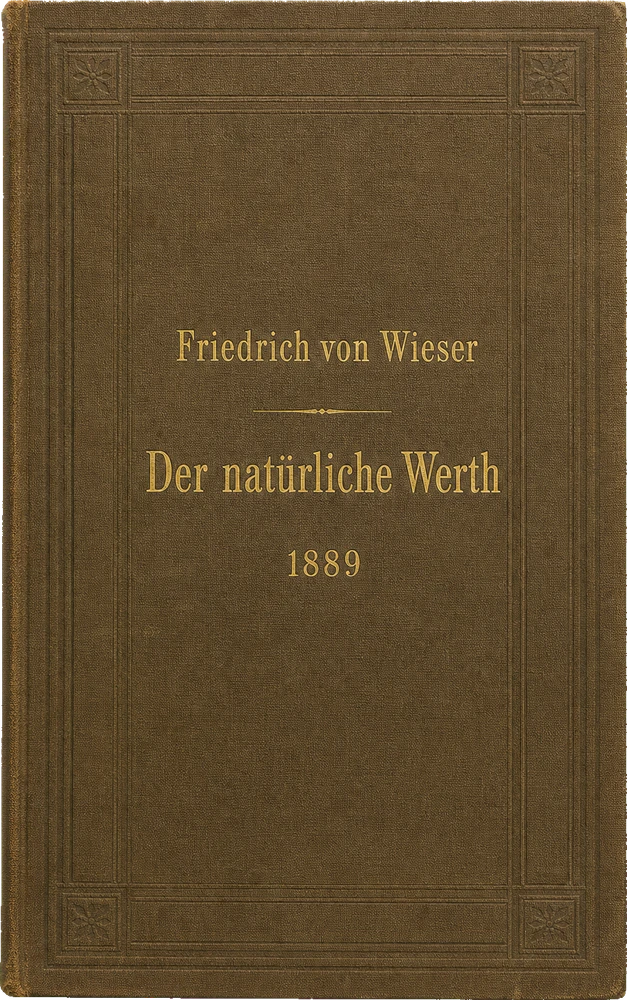
Der natürliche Werth
Friedrich von Wieser · 41 sectionsStrip away private property, monopoly, and the unequal purchasing power of buyers, and goods would still possess a natural value — the worth they would carry in a perfectly rational communist economy from the bare relation of social stocks to social needs. Wieser builds this fiction to isolate the pure logic of valuation, then extends marginal utility from consumption goods to the whole apparatus of production: land, capital, labor, raw materials, and half-finished stock. His theory of imputation assigns each factor its share of the product as a court imputes responsibility among many causes; differential rent, capital interest reached through discounting, and the cost law all follow as special forms of one marginal law. Against the socialist doctrine that labor alone creates value, he warns that a grand idea can end as a childish error.
Der Same, der Baum und der Boden, das Garn, die Kohle und die Maschine sind zwar nicht reife, nicht fertige Güter, sowie die Frucht und das Kleid, aber sie sind ebensowohl Güter.
English translation: “The seed, the tree and the soil, the yarn, the coal and the machine, are indeed not ripe, not finished goods, as are the fruit and the garment, but they are just as much goods.”
- 1884Über den Ursprung und die Hauptgesetze des wirthschaftlichen Werthes
Über den Ursprung und die Hauptgesetze des wirthschaftlichen Werthes
Friedrich von Wieser · 37 sectionsA useful good can seem valuable in itself, yet Wieser locates its value in the satisfactions that depend on possessing it. In this 1884 monograph, he explains why economic valuation is neither simple liking nor a measure of usefulness in general: scarcity makes us attend to what losing an available portion would cost us. His psychological perspective also reverses the apparent authority of production costs, tracing them back to the anticipated utility of products and alternative uses of resources. The stakes extend beyond price theory. Wieser argues that valuing land, labor, and capital remains necessary without private ownership, while distinguishing that necessity from any moral entitlement to income. Readers can discover why practical valuation guides resource allocation without providing an objective numerical measure of wealth.
Die Werthdoctrin ist, wenn wir ihre Aufgabe richtig umschrieben haben, angewandte Psychologie.
English translation: “The doctrine of value, if we have correctly defined its task, is applied psychology.”
- 1891The Austrian School and the Theory of Value
The Austrian School and the Theory of Value
Friedrich von Wieser · 7 sectionsAustrian economics does not copy nature but idealizes it as a geographer's map does, sharpening vision amid the complexities of reality — with this defense against the German historical school's suspicion of abstraction, Wieser opens a compact survey of the young school's doctrine for English readers. Across six movements he lays out its architecture: value drawn wholly from utility, yet only marginal utility; the imputation of joint products to their determining factors, as a magistrate imputes a legal charge; capital, interest, and land value resolved through discounting; and price governed by marginal equivalence, where need meets unequal purchasing power. That last turn is critical — prices register power as much as need, so production follows wants backed by money. He closes by carrying value theory into progressive taxation.
There is no new principle to be discovered, none save utility.
- 1891Über die Valuta-Regulirung in Österreich. Vortrag, gehalten am 19. Jänner 1891 im deutschen Juristenverein zu Prag
Über die Valuta-Regulirung in Österreich. Vortrag, gehalten am 19. Jänner 1891 im deutschen Juristenverein zu Prag
Friedrich von Wieser · 6 sectionsChanging a currency means deciding what old promises are worth in new money. In this 1891 Prague lecture, Friedrich von Wieser supports Austria’s adoption of gold but locates the hardest problem in converting existing gulden obligations. Austria’s suspension of private silver coinage in 1879 had already separated the gulden’s monetary value from its metal content; conversion at bullion value would therefore devalue claims. Yet choosing an exchange rate raises a further conflict: protecting creditors at recent valuations may unsettle exporters whose businesses depend on longer-established rates. Wieser’s distinctive contribution is to separate contractual justice from economic continuity without dismissing either. His analysis shows why monetary reform requires more than selecting a metal: legislation must reconcile inherited obligations, international exchange, and the calculations on which production depends.
- 1892Großbetrieb und Produktivgenossenschaft
Großbetrieb und Produktivgenossenschaft
Friedrich von Wieser · 16 sectionsThe socialist slogan that the means of labour belong to the workers rests, Wieser argues, on a faulty proof — the very demand for land and capital concedes their productive value. Rather than dismiss the grievance, he asks what institutional form could actually join labour, capital, direction and responsibility once the Großbetrieb has severed ordinary workers from ownership and command. His answer is to constitutionalize large-scale enterprise rather than destroy it. A genuine producer cooperative cannot be an association of equal handworkers; it must absorb technical and managerial capacity and grant it proportionate authority, which is why German and Austrian cooperative law, tailored to small producers, leaves such ventures powerless. The French experiments of Godin, Leclaire and Boucicaut supply the model: an 'elite' principle of graded admission into responsibility, extending profit-sharing and eventual partnership without pretending industry can dispense with hierarchy.
Mindestens diejenige Hartnäckigkeit, mit welcher die Techniker die Idee des Luftschiffes auszubilden suchen, muß von den Oekonomen in dieser um so viel näher liegenden Sache bewiesen werden.
English translation: “At the very least, the same tenacity with which engineers pursue the development of the airship must be shown by economists in this matter, which lies so much closer at hand.”
- 1892Gut
Gut
Friedrich von Wieser · 2 sectionsWhat separates a good, in the economic sense, from the good of the moralist or the poet? This lexicon article marks off Gut as the recognized means of want-satisfaction, holding needs broadly enough to span necessities, luxuries and intellectual satisfactions while requiring that a thing's usefulness be known and within human command. From that boundary Wieser draws the distinctions Austrian value theory depends on: free versus economic goods, where scarcity is decisive; consumption goods versus the higher orders of productive means; and goods proper versus mere preconditions like law, knowledge or natural order. Value is traced backward from final wants through the productive structure, and goods become productive only in complementary combinations — land with tools, materials with labour — so that development turns as much on discovering usefulness and arranging complements as on accumulating things.
Bedürfnis wird dabei außerordentlich weit gefaßt, es umfaßt jede Lust, die befriedigt, jede Unlust, die abgewehrt werden soll.
English translation: “Need" is here taken extraordinarily broadly: it comprises every pleasure that is to be satisfied and every pain that is to be warded off.”
- 1892The Theory of Value: A Reply to Professor Macvane
The Theory of Value: A Reply to Professor Macvane
Friedrich von Wieser · 12 sectionsProfessor Macvane, defending Ricardo, had charged the Austrians with smuggling cost into their theory as an afterthought once marginal utility failed. Wieser's rejoinder — which swells from polemic into a full essay against Ricardo himself — turns the accusation around: cost is no rival to marginal utility but a special modification of it, the form value in use assumes under capitalistic production. He dismantles the reduction of all costs to labor, insisting that no actual cost-account contains labor alone, since machines are built with machines and materials with materials. Wages, too, are graded by productive service and scarcity, not by the pain of toil. Exchange itself, he argues, is intelligible only as a mutual gain in use-value; and against Jevons, he holds that value in an age of capital reckons the sacrifice of material means, not merely of effort.
By no form of computation can the factor ‘capital’ be eliminated from the cost of capital.
- 1893Die Besteuerung ausländischer Gläubiger in Oesterreich. Ein Nachwort zum Couponprocesse der Staatsbahn
Die Besteuerung ausländischer Gläubiger in Oesterreich. Ein Nachwort zum Couponprocesse der Staatsbahn
Friedrich von Wieser · 3 sectionsA railway’s agreement to resume paying bond interest in full did not settle whether Austria could tax its foreign creditors. In this 1893 essay, Friedrich von Wieser disentangles the Staatsbahn coupon settlement from the broader claims made on its behalf. His distinctive approach joins economic incidence to legal interpretation: the person formally paying a tax need not bear its burden, and a state’s authority to tax income generated within its territory need not oblige foreign courts to enforce the deduction. Examining conflicting Austrian and German judicial positions, Wieser defends territorial taxing authority without dismissing contractual obligations or practical costs. The essay shows why an apparently simple demand for undiminished interest can conceal separate disputes over who owes, who pays, and which court can compel payment.
- 1893Resumption of Specie Payments in Austria-Hungary
Resumption of Specie Payments in Austria-Hungary
Friedrich von Wieser · 4 sectionsA rising currency can unsettle an economy as surely as a falling one. In this 1893 article, Friedrich von Wieser examines Austria-Hungary’s unfinished return to specie payments through the competing claims of exporters, debtors, creditors, and the state. His central problem is how to adopt gold without overturning contracts and business expectations formed under paper money. The gulden’s ability to retain a value above its silver content gives the inquiry a theoretical edge: monetary value cannot simply be read off the metal in a coin. Wieser treats gold as a practical response to international obligations, while distinguishing the purchase of reserves from genuine convertibility. His analysis makes the conversion ratio visible as a consequential distributional choice, not merely a technical calculation.
- 1894Die Währungsfrage und die Zukunft der österreichisch-ungarischen Valutareform: Vortrag gehalten am 22. Jänner 1894 im Prager deutschen kaufmännischen Vereine
Die Währungsfrage und die Zukunft der österreichisch-ungarischen Valutareform: Vortrag gehalten am 22. Jänner 1894 im Prager deutschen kaufmännischen Vereine
Friedrich von Wieser · 5 sectionsDevised by specialists yet ratified in daily trade only by the public that accepts or refuses it, money is for Wieser a social convention resting at once on law, metal, and fiscal credibility. Arguing before Prague's German commercial association for completing Austria-Hungary's currency reform, he stakes out a moderate position between doctrines. Against the bimetallist Dr. Arendt, who invoked Eduard Suess's geology to predict a coming scarcity of gold, he insists the empire must obtain gold to escape its paper-money isolation; against pure gold zealots, he refuses to treat inherited silver as a disposable remnant. Europe, he observes, runs not on a clean gold standard but on a mixed one-and-a-half arrangement of gold coin, retained silver, and token money. Currency reform, he concludes, stands or falls with budgetary discipline: agio is the monetary face of deficit finance.
Die Angelpunkte der Situation liegen weder in den Goldminen von Afrika, noch in der Münzpolitik der Vereinigten Staaten und Indiens, noch auf dem Londoner Markte, noch sonstwo ausserhalb, sie liegen in Wien und Budapest.
English translation: “The pivotal points of the situation lie neither in the gold mines of Africa, nor in the coinage policy of the United States and India, nor on the London market, nor anywhere else abroad; they lie in Vienna and Budapest.”
- 1897Die Reform unserer directen Steuern
Die Reform unserer directen Steuern
Friedrich von Wieser · 7 sectionsA tax reform can leave total revenue largely unchanged while altering whose resources the state may legitimately claim. In this 1897 lecture, Friedrich von Wieser assesses Austria’s direct-tax reform by that distributive test. His defence of progressive income taxation rests on a concrete distinction: income needed for subsistence and dependants is not equivalent to income available for public purposes. Yet fiscal justice also requires attention to production; taxes that appear to burden property owners may discourage new housing and enterprises. Wieser’s qualified endorsement brings economic incentives into contact with constitutional obligations, asking whether moderate rates and taxpayer participation can make honest declarations credible. The lecture offers a precise encounter with the tension between equitable assessment, productive investment, and the stronger state authority that reform could sustain.
- 1900Grenznutzen
Grenznutzen
Friedrich von Wieser · 14 sectionsBecause nature yields no secure abundance, every economy must rank its satisfactions and stop at a boundary — the last admissible use of a stock, which Wieser names the Grenznutzen. This encyclopedia article compresses a whole system into ten steps, from economizing under scarcity through value, the disutility of labour, imputation, factor incomes, costs, price, money and tax justice. Marginal utility becomes a general language: goods are valued not by total but by dependent utility, labour-value is rejected because most goods cannot be reproduced by 'bloße Arbeit', costs are recast as the productive utility sacrificed elsewhere, and rent and interest survive because even a socialist plan would have to impute yield to scarce land and capital. Appended memorial pages on Carl Menger trace the school's origin to his 1871 Grundsätze.
Ohne produktive Zurechnung käme der Plan der gesellschaftlichen Produktion in ratlose Verwirrung.
English translation: “Without productive imputation the plan of social production would fall into helpless confusion.”