- 1908
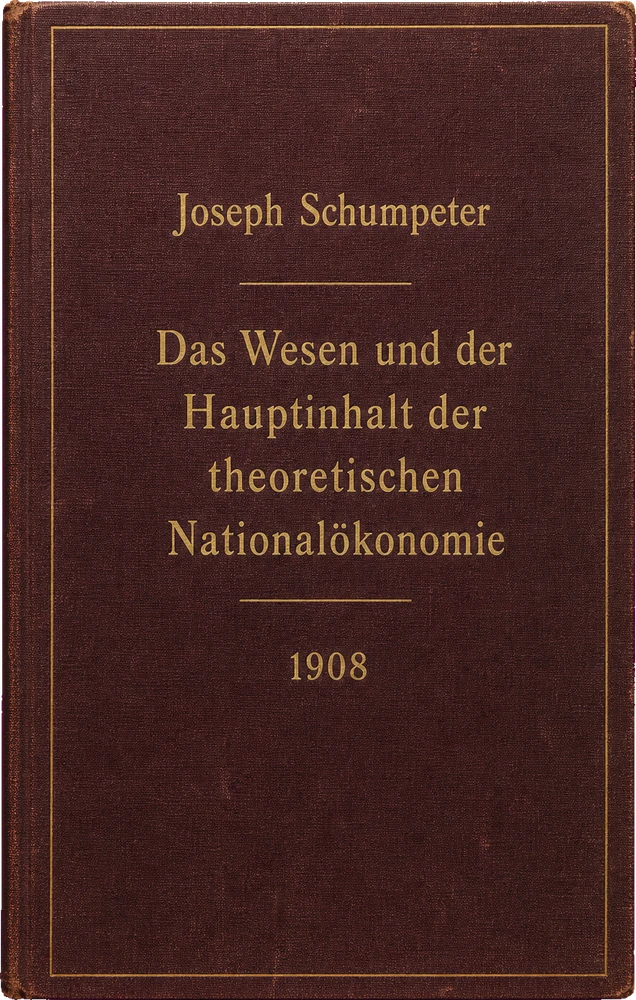
Das Wesen und der Hauptinhalt der theoretischen Nationalökonomie
Joseph Alois Schumpeter · 120 sectionsAgainst economics built from one-way chains of cause and effect, Schumpeter's founding statement of pure theory isolates a single object: the relations among economic quantities. Written amid the Methodenstreit, it replaces causal narration with interdependence—prices and quantities are intelligible only within a system where each element presupposes the others—and derives the marginal-utility level as its formal core. Statics, the moment-photograph of equilibrium, explains mutual adjustment under given conditions but cannot explain what arises when the system is disturbed from within. That limit surfaces most sharply in interest, which Schumpeter refuses to derive from the productivity of capital goods or from ordinary loans. Interest belongs instead to development and to newly created credit, the mechanism that breaks the circular flow and finances new enterprise—already foreshadowing the theory of capitalist change to come.
Die Neuschaffung von Kredit ist das Essentielle.
English translation: “The creation of new credit is the essential thing.”
- 1905Die Methode der Index-Zahlen
Die Methode der Index-Zahlen
Joseph Alois Schumpeter · 6 sectionsA price index can change even when prices do not—if the mixture of goods it measures has changed. In this seminar paper published in 1905, Joseph Alois Schumpeter treats such difficulties as questions about what economic measurement can legitimately claim. His guiding distinction is between describing price movements and explaining their causes: an aggregate cannot, by itself, identify monetary influences. No index is best for every purpose. Counting both raw materials and finished products can multiply particular price influences; holding weights fixed can preserve comparability while losing touch with consumption. Readers encounter the economic choices embedded in apparently technical formulas, and the tension between measuring purchasing power consistently and representing an economy whose goods, qualities, and quantities keep changing.
- 1906Professor Clarks Verteilungstheorie
Professor Clarks Verteilungstheorie
Joseph Alois Schumpeter · 8 sectionsTo answer the socialist charge of exploitation with a theorem rather than a sermon—that is the ambition Schumpeter reconstructs in John Bates Clark's theory of distribution, presented here in deliberately uncritical exposition. In Clark's static state, abstracting from population growth, accumulation and technical change, free competition awards each factor the share of product it creates: to labor, capital and land its own. The argument turns on a distinctive capital concept—a durable, mobile fund embodied in perishable capital-goods, with land folded in—and on extending the law of diminishing returns from land to capital and symmetrically to labor, so that final productivity governs wages and interest alike. Schumpeter lets the assumptions show plainly, for the promised unity of wages, interest and rent depends on treating equal factor-units as equal productive contributions.
Clark's These ist nun die, daß in diesem statischen Zustande jeder Produktionsfaktor beim Walten freier Konkurrenz jenen Anteil am Produkte erhält, den er hervorbringt, daß also der Arbeit, wie dem Kapital und dem Lande, ihr, beziehungsweise sein Produkt zufällt.
English translation: “Clark's thesis is now this: that in this static state every factor of production, under the reign of free competition, receives that share of the product which it brings forth—so that to labor, as to capital and to land, its respective product falls.”
- 1906Rudolph Auspitz
Rudolph Auspitz
Joseph Alois Schumpeter · 1 sectionsA sugar manufacturer who stood to gain from protection yet campaigned as a consistent free trader, refused the cartel, and quietly diverted his unavoidable trust profits into a pension fund for his clerks—Rudolph Auspitz is memorialized by Schumpeter as both a public man of rare disinterest and a first-rate mathematical economist. The obituary weighs his work on taxation and the 1896 fiscal reform, then turns to the 1889 Untersuchungen über die Theorie des Preises, written with Richard Lieben. Auspitz, it argues, held marginal value theory to complete and partly correct Ricardo rather than overthrow him, and from the parallel treatment of production and consumption drew the consumer's rent, the producer's rent, and the gain of the community.
It is, generally, a characteristic point, which deserves to be noted, that during his whole political life he was not only completely free from any personal aspiration, but also from class interest.
- 1906Über die mathematische Methode der theoretischen Ökonomie
Über die mathematische Methode der theoretischen Ökonomie
Joseph Alois Schumpeter · 10 sectionsRejecting mathematics in economics does not protect social complexity; it only deprives theory of its most adequate logical language. Schumpeter argues that once economics reasons about value, price, exchange, labor, interest and time, it is already handling quantities, so the economist who states proportionalities and marginal changes in words is doing arithmetic while refusing the calculus his own arguments require. Mathematics, on this view, is a logical form that imports nothing foreign and can therefore introduce nothing false; it clarifies functional dependence, continuity, and maxima even where numerical data are missing. Drawing on Cournot's proof that monopoly price exceeds competitive price and Walras's system of exchange equations, he shows the method uncovering relations that verbal exposition confuses—while insisting it can never calculate a practical policy out of a formula.
Also: Arbeit, Ware, Zeit, Preis, Zins u. s. w. sind Quantitäten.
English translation: “Thus: labor, commodity, time, price, interest, etc., are quantities.”
- 1907Das Rentenprinzip in der Verteilungslehre
Das Rentenprinzip in der Verteilungslehre
Joseph Alois Schumpeter · 20 sectionsCan a single idea—income as a surplus over outlay—explain wages, interest, land rent, monopoly gain and entrepreneurial profit at once? Schumpeter maps this rent principle from Ricardo's differential rent through urban sites, patents, personal ability and Clark's final productivity, then dismantles it. His decisive move is to demote the law of diminishing returns: it is a technical fact about production, not a purely economic law, and it cannot determine income shares once every factor can be brought under it. Set against the exchange principle, which treats distributive incomes as prices of productive services, the rent surplus merely restates results already fixed by value and price theory. He concludes, against Ricardo, that classical ground-rent theory is not a theory of ground rent at all, and grounds distribution in imputation instead.
Analysen der Erscheinungen und nicht Definitionen geben Erkenntnisse.
English translation: “It is analyses of phenomena, not definitions, that yield insight.”
- 1909Bemerkungen über das Zurechnungsproblem
Bemerkungen über das Zurechnungsproblem
Joseph Alois Schumpeter · 11 sectionsThe value of bread must somehow reach back to the land, labor and tools that make it—yet deriving the values of productive goods from those of the consumption goods they yield is a knot that practice unties daily while theory struggles to. Schumpeter works at this imputation problem by reading Austrian value theory architectonically, premise by premise. He reconstructs Wieser's system of equations, which allocates a product's value among its factors and lets distribution flow directly from imputation, and shows it standing or falling with one assumption: that every unit of a stock is valued alike, so total value equals marginal utility times quantity. Against it he sets Böhm-Bawerk's principles of complementarity, loss and substitution, faulting the claim that a replaceable factor can never exceed its substitution value. The true task, he concludes, is to derive whole value-curves of productive goods, not single marginal shares.
Auch die Produktivgüter, auch Land, Kapital und Arbeit müssen um ihres Nutzens willen Wert empfangen, sofern sie nicht im Überflusse vorhanden sind.
English translation: “Productive goods too—land, capital, and labor as well—must receive value for the sake of their utility, insofar as they are not present in superabundance.”
- 1909On the Concept of Social Value
On the Concept of Social Value
Joseph Alois Schumpeter · 8 sectionsSociety shapes what people desire, but it is not itself a wanting organism—so social value, Schumpeter argues, has no natural meaning in a competitive economy. Only a community that consciously acts as one, as under communism, could possess social utility curves and social marginal utilities. His real target is the optimistic distributive doctrine of Clark, Wieser and Carver, which holds that competition pays each factor what its service is worth to the community. Competitive prices, he counters, rest on individual valuations, ownership, bargaining position, and above all the given distribution of wealth; they cannot be read as the disguised verdict of an organized society. To fix values is not yet to fix prices, he insists, and social value survives only as a scientific fiction outside the communistic case.
For only individuals can feel wants.
- 1911Neuere Erscheinungen auf dem Gebiete der Nationalökonomie
Neuere Erscheinungen auf dem Gebiete der Nationalökonomie
Joseph Alois Schumpeter · 17 sectionsRanged across a season's new books—methodology, Marx and Christianity, money, capital, Australian policy, the history of note-issuing banks—these review-notices double as a manifesto for how economics should be done. Schumpeter judges each work by whether it solves problems rather than parading method or ideology: every theory, he holds, must be known by its fruits, and declaring allegiance to theory is not itself theoretical work. He defends marginal utility against the charge of being capitalist in tendency, praises Davenport's Value and Distribution for its unadorned analysis and its treatment of capital as an unspecialized loan-fund, and admires Fisher's Rate of Interest for binding theory to statistics—while denying that time-preference alone can explain interest, since interest must also depend on the growing stream of future goods. Ruhland's moralized system, which reduces capital to greed, he sharply rejects.
Es gilt Probleme zu lösen, nicht Methoden zu diskutieren.
English translation: “The task is to solve problems, not to discuss methods.”
- 1913Zinsfuß und Geldverfassung
Zinsfuß und Geldverfassung
Joseph Alois Schumpeter · 8 sectionsThe businessman takes it as self-evident that credit and available money govern the rate of interest; orthodox theory insists interest springs only from the scarcity of real capital. Schumpeter cuts between them. Defining the monetary constitution broadly, to include coinage, bank credit, central-bank policy, collateral, and crisis lending, he asks where money can actually move interest and locates it in one case: credit issued without prior saving. Such bank-created purchasing power works as a forced saving, letting entrepreneurs bid resources away from routine uses, so that interest becomes bound to the credit-financed process of development rather than to a timeless yield of capital. Banks emerge as gatekeepers authorizing which ventures command resources. He partly rehabilitates Locke, Law, and Montesquieu against Hume and Smith, while likening a lowered interest rate to morphine, relief without cure.
Gibt es eine Beziehung zwischen Kapitalzins und Geldverfassung oder, anders, kann der Kapitalzins durch die Geldverfassung beeinflußt werden?
English translation: “Is there a relationship between the rate of interest on capital and the monetary constitution—or, put differently, can the rate of interest on capital be influenced by the monetary constitution?”
- 1914Das wissenschaftliche Lebenswerk Eugen von Böhm-Bawerks
Das wissenschaftliche Lebenswerk Eugen von Böhm-Bawerks
Joseph Alois Schumpeter · 9 sectionsComposed in the immediate wake of Böhm-Bawerk's death, this commemorative essay converts personal reverence into a claim about intellectual scale: that the Austrian finance minister and theorist was not merely a capital theorist but a founder of exact economic analysis. Schumpeter reads the major works, from Rechte und Verhältnisse through the Geschichte und Kritik der Kapitalzinstheorien and the Positive Theorie des Kapitals to the Marx critique, as a single architecture built from Menger toward a general theory of the economic process. At its center stands capital as roundabout production and the agio theory of interest, grounded in the higher valuation of present over future goods for three reasons: differing provision, the perspectival underestimation of future wants, and the productivity of longer production. Interest, he insists, is a purely economic category that would persist even in a socialist commonwealth.
Sein Werk gehört nicht einer Generation oder einem Volk, sondern der Menschheit.
English translation: “His work belongs not to a single generation or a single people, but to humanity.”
- 1914Epochen der Dogmen- und Methodengeschichte
Epochen der Dogmen- und Methodengeschichte
Joseph Alois Schumpeter · 39 sectionsEconomics became a science, on Schumpeter's telling, only when it moved beyond isolated practical disputes to grasp the national economy as an interconnected circular flow, the breakthrough he credits to Quesnay and the tableau economique. This survey, written for the 1914 Grundriss der Sozialoekonomik, traces the discipline from two roots, a philosophical natural-law tradition and a practical-policy literature, through physiocracy and the classical system of Smith, Ricardo, and Mill, into the Methodenstreit between Menger's defense of theory and Schmoller's historical school, and finally to the marginal utility revolution of Menger, Jevons, and Walras. He judges every school by whether it obstructs or enriches analysis, and argues that beneath the noisy polemics of method lies an organic continuity, one hundred fifty years of cumulative work whose unity later observers will more easily perceive.
Wirklich bedeutende Gegensätze gibt es innerhalb dieser Preistheorie nicht mehr.
English translation: “Within this theory of price there are no longer any really significant oppositions.”