- 1937
Prosperity and Depression: A Theoretical Analysis of Cyclical Movements
Gottfried Haberler · 131 sectionsWhy do ordinary disturbances in a market economy swell into cumulative waves of boom and slump rather than dying away? Commissioned by the League of Nations to survey the whole field, Haberler refuses every single-cause answer — money alone, saving alone, technology alone, psychology alone — and instead tests each theory for logical consistency and mutual compatibility. He weighs Hawtrey's purely monetary account against the over-investment theories of Hayek, Mises and Spiethoff, distinguishes vertical from horizontal maladjustment, and shows that the acceleration principle and over-investment theory are complementary rather than rival explanations. His synthesis treats prosperity and depression as phases of one unstable adjustment mechanism, in which credit, forced saving, inventories and confidence magnify change and then reverse it.
Deflation in the sense of a gradual decrease in the total demand for goods in terms of money plays an essential rôle in the contraction process.
- 1940
Nationalökonomie: Theorie des Handelns und Wirtschaftens
Ludwig von Mises · 235 sectionsWritten in Geneva at the Institut Universitaire de Hautes Etudes Internationales, this thousand-page treatise is the German-language predecessor of Mises's later Human Action, grounding economics in praxeology, the general science of human action. He builds from a single a priori insight, that man acts to exchange a less satisfactory state for a more satisfactory one, and unfolds from it marginal utility, the Ricardian law of association, time preference, and monetary calculation. Along the way he dismantles the socialist calculation problem, polylogism in its Marxist and racial-biological forms, and the notion that history can be read without theory. Money prices, he argues, are the indispensable tool that lets a division-of-labor economy coordinate production at all, the reason socialism remains, for him, a system that cannot calculate.
Der Markt lenkt, der Markt bringt in das Getriebe Sinn und Ordnung.
English translation: “The market directs; the market brings meaning and order into the machinery.”
- 1941
The Pure Theory of Capital
Friedrich August von Hayek · 40 sectionsNo single measurable fund could capture what capital really is: a heterogeneous, time-ordered structure of goods, plans, and expected outputs whose central problem is intertemporal coordination. Hayek's 1941 treatise dismantles the inherited abstractions, the average period of production and the tidy split between fixed and circulating capital, arguing that a machine or half-finished good counts as capital only by its place within a structure of expectations about future services. Written against the backdrop of Böhm-Bawerk, Wicksell, and Keynes, it shows how credit-driven interest rates below the level warranted by genuine saving lure entrepreneurs into lengthening production the economy cannot complete, so that a scarcity of capital surfaces as a shortage of consumers' goods. The book supplies the capital-theoretic foundation of Austrian business-cycle theory.
We see, therefore, that if we treat the problem in real terms and in its simplest forms, an increase in the demand for consumers’ goods not only does not increase but actually decreases the demand for labour.
- 1944
The Road to Serfdom: Text and Documents--The Definitive Edition
Friedrich August von Hayek · 25 sectionsThe dedication is itself a provocation: 'to the socialists of all parties.' Hayek's wartime tract contends that the road to tyranny is paved by well-meaning planners. Central economic direction, he argues, cannot stop at economics, because the same apparatus can serve any master; it erodes the Rule of Law, hollows out democracy, and rewards the ruthless, the mechanism behind his chapter 'Why the Worst Get on Top.' Fascism and communism appear here not as opposites but as sibling outcomes of collectivist control, and Nazism as the fruit of German socialist ideas rather than a reaction against them. This definitive edition restores Hayek's text alongside the prefaces of 1956 and 1976, in which he tracks socialism's drift from nationalization toward the welfare state while reaffirming the book's core alarm.
Economic control is not merely control of a sector of human life which can be separated from the rest; it is the control of the means for all our ends.
- 1944
Omnipotent Government: The Rise of the Total State and Total War
Ludwig von Mises · 90 sectionsNazism, in this wartime reckoning, is no German aberration but the sharpest edge of a wider revolt against liberalism — the point where interventionism, socialism, protectionism, and nationalism converge. Written in 1944, the book judges each doctrine by whether its policies can reach their promised aims, and finds that the pursuit of security through state command ends in economic disorder and war. Mises's decisive link runs from economic nationalism to aggressive nationalism: once governments regiment currencies, wages, imports, and migration, territory itself becomes the prize, autarky grows attractive, and conquest becomes economic policy carried on by other means. He dissects polylogism — the claim that races or classes reason by separate logics — as the device that immunizes ideology from argument, treating Nazi racial thought less as a scientific error than as a repudiation of the universal reason on which free discussion depends.
The choice for mankind is not between two economic systems. It is between capitalism and chaos.
- 1947
Planned Chaos
Ludwig von Mises · 14 sectionsThe twentieth century's disorder, Mises argues here, is not capitalism failing but the failure of every attempt to obstruct capitalism while keeping its fruits. Drawn from his treatise Socialism, this compact polemic dismantles interventionism—the faith that government can correct markets through selected controls without abolishing private enterprise. A wage law above the market rate breeds unemployment; a price ceiling breeds shortage; each remedy forces retreat or wider command until planning becomes total. He reads Leninism, Stalinism, Trotskyism, Fascism, and Nazism as rival forms of dictatorial anti-capitalism, distinguishing open Russian state ownership from the German Zwangswirtschaft that leaves owners in name while binding them to official orders. Beneath the whole case lies the calculation problem: without market prices for the means of production, planners may issue commands but cannot know whether they economize or squander.
The market is a democracy in which every penny gives a right to vote.
- 1949
Human Action: A Treatise on Economics, The Scholar's Edition
Ludwig von Mises · 294 sectionsPraxeology - Mises's name for the general science of human action - is the foundation on which this treatise rebuilds the whole of economics, from the law of marginal utility to the monetary theory of the trade cycle. Restoring the 1949 first edition, the Scholar's Edition presents Mises's fullest synthesis: catallactics as the study of market exchange, methodological individualism set against collectivist wholes, and the argument that socialism, lacking money prices for the means of production, cannot rationally calculate. He dismantles the polylogism of Marx and the racial theorists, distinguishes class probability from case probability, and defends the market as a consumers' democracy in which profit and loss steer production. Across seven parts, laissez-faire emerges not as dogma but as the conclusion of a rigorous, a priori chain of reasoning.
Economics is not about things and tangible material objects; it is about men, their meanings and actions.
- 1952
The Sensory Order: An Inquiry into the Foundations of Theoretical Psychology
Friedrich August von Hayek · 54 sectionsWhy should a world that physics arranges as wavelengths and frequencies be lived as colors, sounds, and pains? An economist's answer, drafted from ideas Hayek first formed as a Vienna student around 1920, reframes theoretical psychology around that gap. Sensory qualities, he contends, are not mental atoms or copies of external properties but products of classification: a stimulus has the quality it does because of the place its neural impulse occupies within a vast network of connexions built by inherited organization and past learning. Mind becomes an adaptive classifying apparatus, an order of relations rather than a substance, and perception an act of interpretation that precedes conscious experience. The argument anticipates connectionist models of cognition and mirrors, in the nervous system, the same concern with emergent order that drives Hayek's economics.
This order which we call mind is thus the order prevailing in a particular part of the physical universe—that part of it which is ourselves.
- 1956
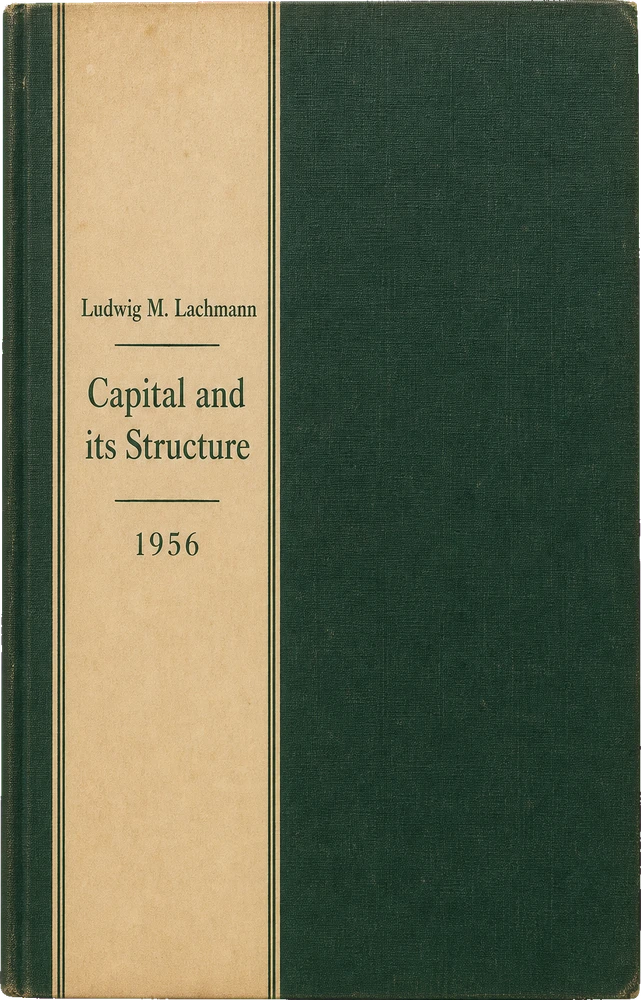
Capital and Its Structure
Ludwig M. Lachmann · 22 sectionsCapital has no measurable counterpart among material objects; it exists only in the entrepreneur's appraisal of heterogeneous goods—and from that premise Lachmann builds an entire theory. Against the aggregate 'quantity of capital,' he substitutes an ordered pattern of capital combinations, deriving multiple specificity, complementarity, and finally capital structure from the plain fact that capital resources are heterogeneous. Expectations are interpretive acts, not mechanical data; prices communicate knowledge but must be decoded, some movements meaningful and others functionless. Process analysis follows plans through disappointment, regrouping, and fresh disequilibrium, while forward markets and the Stock Exchange help coordinate divergent expectations that price rigidity would betray. Reinterpreting Böhm-Bawerk's roundaboutness as changing composition rather than more time, and applying the framework to the strong boom, this 1956 work makes capital theory a study of order, failure, and regrouping.
The Theory of Capital is, in the last resort, the morphology of the forms which this pattern assumes in a changing world.
- 1956
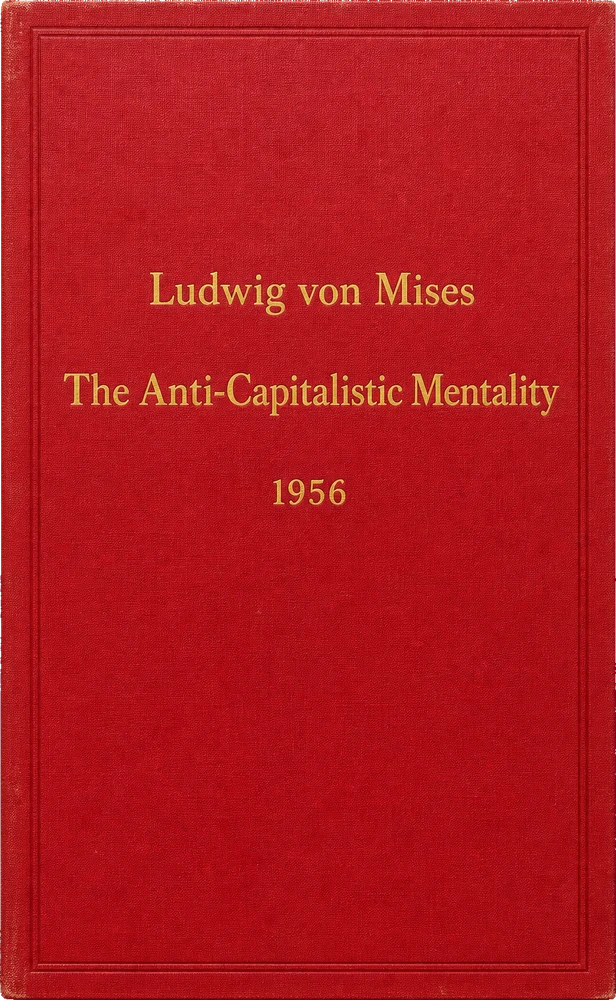
The Anti-Capitalistic Mentality
Ludwig von Mises · 26 sectionsA society that abolishes inherited caste also abolishes every excuse for failure—and that, in Mises's diagnosis, breeds the resentment that fuels hatred of capitalism. Under equality before the law, the disappointed clerk, the intellectual, the idle 'cousin,' the anxious entertainer can no longer blame birth for falling short of those whom consumers preferred, so disappointment curdles into moral accusation. Beneath this psychology lies an economic core: prosperity flows not automatically from technology but from saving, capital accumulation, and private property under consumer sovereignty, and only more capital per worker can durably raise real wages. Extending the argument into literature, censorship, and the Cold War, Mises reads detective stories and 'social' novels as forms of envy and dismisses sham anticommunists who reject Soviet violence while embracing the planning that produces it.
Nature is not bountiful but stingy.
- 1957
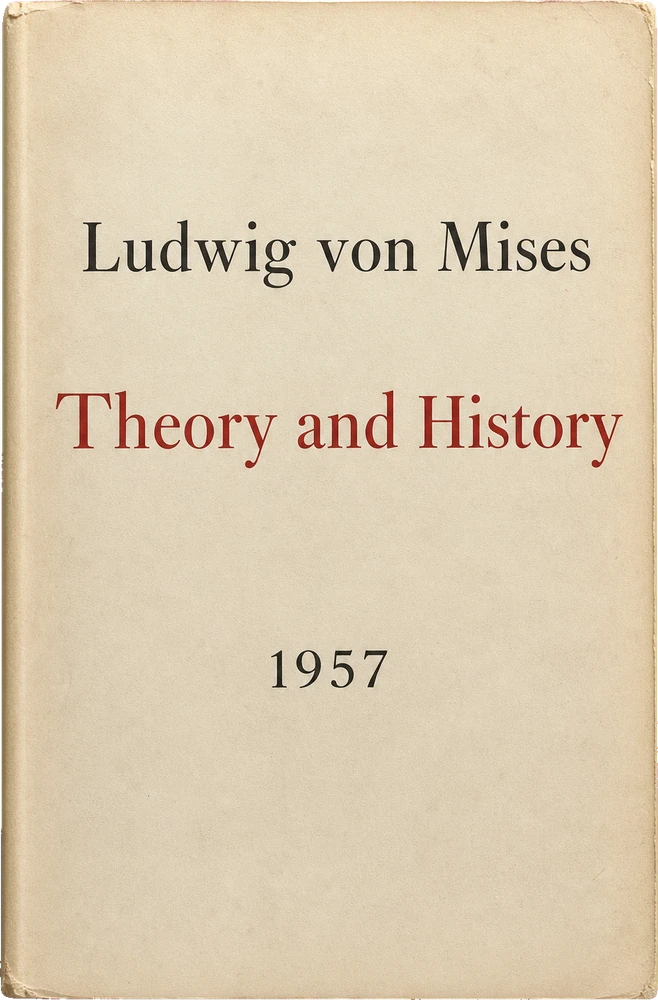
Theory and History: An Interpretation of Social and Economic Evolution
Ludwig von Mises · 95 sectionsWhere the natural sciences explain events from without, the sciences of human action must interpret purpose and meaning from within - a divide Mises calls methodological dualism and makes the cornerstone of this, the philosophical companion to Human Action. He defends it against positivism, behaviorism, and the econometric ambition to imitate physics, arguing that human affairs contain variables but no constants, so statistics can never test a theory the way a laboratory does. Half the book dismantles Marx's dialectical materialism, showing that tools and machines are themselves products of mind and that the ideology doctrine was contrived to evade economic criticism of socialism. The rest maps the epistemology of history proper: the role of the individual against the myth of the group mind, the discipline of thymology, and the refusal of every philosophy of history that claims to know mankind's destined end.
History deals with values, but it itself does not value.
- 1960
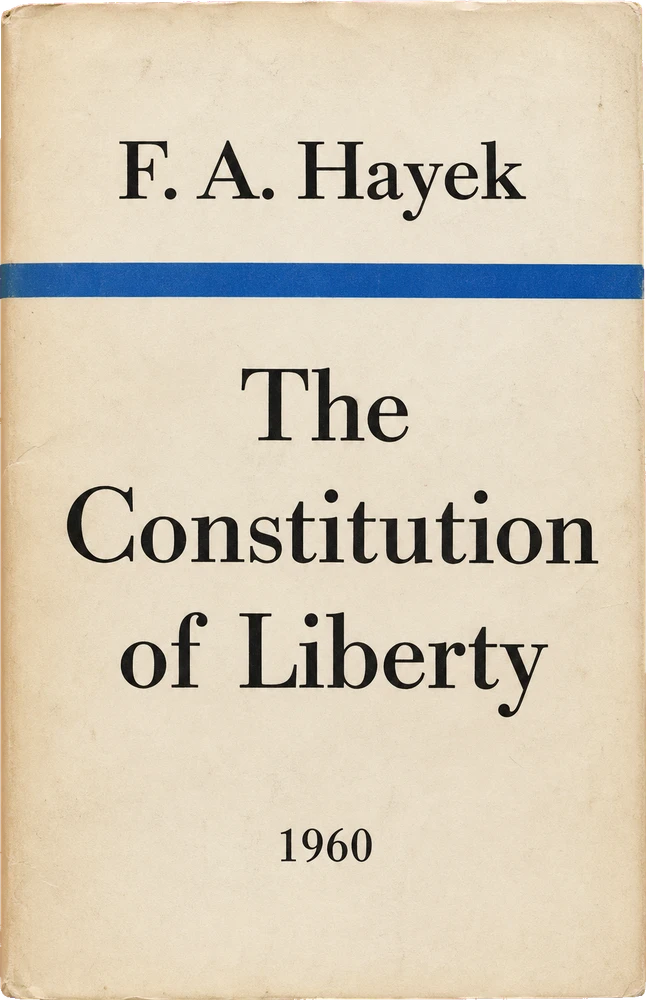
The Constitution of Liberty
Friedrich August von Hayek · 135 sectionsCoercion of some by others, reduced as far as a society can manage it, that spare definition of freedom anchors Hayek's most systematic statement of liberal principle. The argument climbs from epistemology to constitution to policy on a single premise: no mind or authority commands the knowledge needed to direct social life, so liberty matters less for the nobility of its uses than because its results cannot be foreseen. Part I defends progress, tradition, responsibility, and inequality as conditions of discovery; Part II makes the rule of law, general, prospective, impersonal, the answer to arbitrary command; Part III tests the welfare state, rejecting redistributive planning, union privilege, and progressive taxation while allowing a safety minimum under general rules. A closing postscript explains why the defender of inherited restraints is nonetheless not a conservative.
Freedom granted only when it is known beforehand that its effects will be beneficial is not freedom.