- 1931
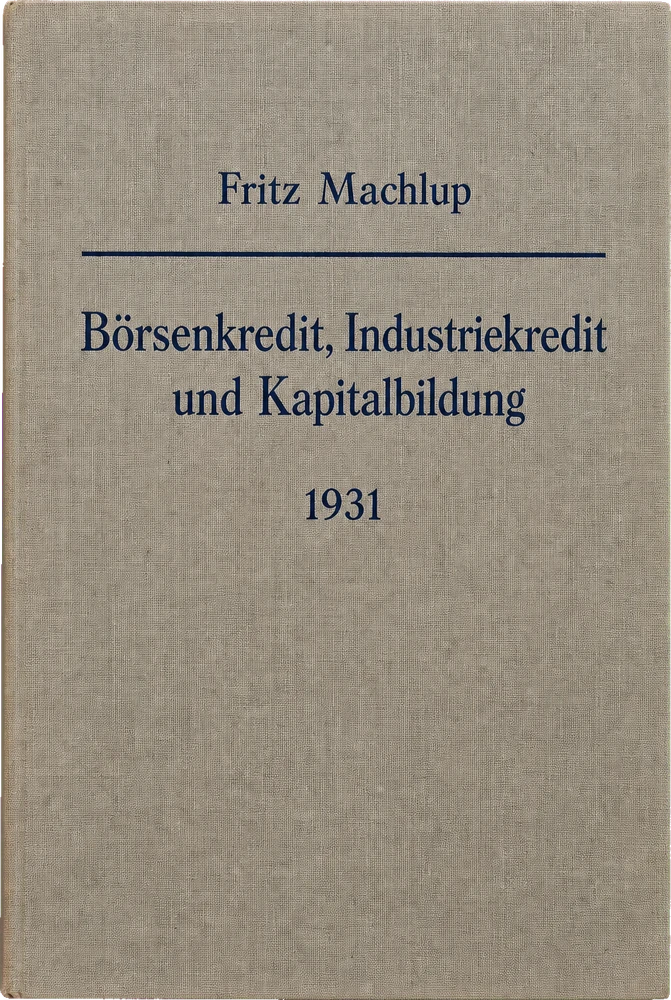
Börsenkredit, Industriekredit und Kapitalbildung
Fritz Machlup · 36 sectionsIn interwar debates over lending to booming securities markets in Germany and the United States, popular hostility held that stock-exchange credit drains resources from industry and manufactures crises. First published in 1931 in the Beitraege zur Konjunkturforschung series of the Austrian Institute for Business Cycle Research, then directed by Hayek, this study recasts that accusation as a precise question: what is actually taken up when securities are bought on credit? Machlup's answer turns on the distinction between Realkapital, produced means of production, and Kapitaldisposition, command over investible purchasing power. Speculation shifts claims and prices without immobilizing plant; only bank credit created beyond genuine saving binds capital, as a localized inflation that later distorts the production structure. The securities market, he concludes, is the principal channel of industrial credit, not its enemy.
Realkapital — produzierte Produktionsmittel — also Ziegelsteine, Eisenträger, Maschinen, Drahtstifte, Hebekrane usw. werden von der Effektenspekulation weder absorbiert noch aufgesaugt, noch gebunden.
English translation: “Real capital—produced means of production—that is, bricks, iron girders, machines, wire nails, cranes, and so on, is neither absorbed nor soaked up nor tied up by securities speculation.”
- 1925Die Goldkernwährung: Eine währungsgeschichtliche und währungstheoretische Untersuchung; mit einem Anhang: Ricardo's Währungsplan aus dem Jahre 1816
Die Goldkernwährung: Eine währungsgeschichtliche und währungstheoretische Untersuchung; mit einem Anhang: Ricardo's Währungsplan aus dem Jahre 1816
Fritz Machlup · 33 sectionsA currency can remain a gold currency without ever putting gold into everyday hands—this is the paradox Machlup sets out to define rather than to sell. Separating the monetary standard from the physical medium of payment, he argues that gold need not circulate as coin if it is concentrated as a reserve behind a system held at parity through the Umtauschprinzip, the rule of convertibility between domestic and foreign money at a fixed rate. Tracing the idea to Ricardo's neglected 1816 ingot plan, appended here, and testing it against India, the South American conversion offices, and Austria-Hungary's own krone, he shows the arrangement economizes scarce gold while preserving discipline. The system is not self-enforcing: its sole danger, he insists, lies in inflationary measures.
Goldkernwährung bedeutet Goldkonzentration.
English translation: “The gold-core standard means the concentration of gold.”
- 1927Rezension: Dierschke und Müller (Hg.), Die Notenbanken der Welt
Rezension: Dierschke und Müller (Hg.), Die Notenbanken der Welt
Fritz Machlup · 2 sectionsA reference work can be theoretically uneven yet remain useful: this distinction governs Fritz Machlup’s brief 1927 review of Dierschke and Müller’s Die Notenbanken der Welt. Covering 57 note-issuing institutions, the two-volume compilation required thirteen contributors to bring its accounts to a common, reasonably recent endpoint. Machlup recognizes the cost of that collaboration in divergent theoretical outlooks and judgments, though he names no specific error. His interest lies in weighing those shortcomings against the practical value of the assembled histories, statutes, and institutional descriptions. The review offers a compact instance of his critical priorities: interpretive consistency matters, but its absence need not disqualify a documentary resource.
- 1928Währung und Auslandsverschuldung. Bemerkungen zur Diskussion zwischen Schacht und seinen Kritikern
Währung und Auslandsverschuldung. Bemerkungen zur Diskussion zwischen Schacht und seinen Kritikern
Fritz Machlup · 5 sectionsExcessive foreign borrowing can burden taxpayers without making repayment a threat to currency stability. That distinction drives Fritz Machlup’s 1928 intervention in the dispute between Hjalmar Schacht and his critics. Machlup shares their concern about Germany’s debts but challenges the assumption that a country’s difficulty raising payments proves an independent inability to transfer them abroad. He traces how setting aside repayment funds reduces domestic purchasing power, changing imports, exports, and the availability of foreign exchange—provided new credit does not undo that withdrawal. His argument connects municipal budgets with the monetary mechanics of reparations under the Dawes Plan. It offers readers a precise way to distinguish fiscal hardship from transfer obstacles, while exposing the policy assumptions on which his account of adjustment depends.
- 1929Geldtheorie und Konjunkturtheorie
Geldtheorie und Konjunkturtheorie
Fritz Machlup · 1 sectionsStable prices and unchanged lending rates need not mean that investment is aligned with saving. This is the central challenge Fritz Machlup develops in his 1929 review of F. A. Hayek’s identically titled book. He explains why improved profit opportunities can set credit expansion in motion without banks first cutting rates, and why bankers who merely accommodate demand may collectively finance investment beyond available savings. His perspective is sympathetic but not deferential: while praising Hayek’s account of monetary causation, he disputes the concession that changes in voluntary saving alone can explain the characteristic passage from boom to crisis. The review offers a concrete way to distinguish what initiates an expansion from what allows it to become unsustainable—and monetary explanation from moral blame directed at bankers.
- 1929Rezension: R. Kuczynski, Deutsche Anleihen im Ausland 1924 bis 1927
Rezension: R. Kuczynski, Deutsche Anleihen im Ausland 1924 bis 1927
Fritz Machlup · 1 sectionsBefore judging Germany’s foreign borrowing, what debts had actually been incurred, by whom, and on what terms? In this short review, Fritz Machlup praises Kuczynski’s documentation for giving a noisy controversy a factual footing. His distinction is pointed: he values systematic empirical work while distancing it from the “empirical-realist” school of economics. Praise is tempered by unease over public bodies’ substantial share of foreign debt and by the suggestion that official interventions probably worsened borrowing terms. The review offers a compact instance of Machlup’s critical priorities: reliable evidence is necessary for policy argument, but collecting it does not settle whether borrowing abroad is desirable.
- 1930Rezension: H. Oswalt, Grundzüge der Geldtheorie
Rezension: H. Oswalt, Grundzüge der Geldtheorie
Fritz Machlup · 1 sectionsTrust may explain why people accept money, but does it explain how much money will buy? In this 1930 review of H. Oswalt’s Grundzüge der Geldtheorie, Fritz Machlup praises a monetary primer that keeps these questions distinct. His admiration for Oswalt’s teaching is tempered by a precise objection: calling a commodity’s price its “objective exchange value” does not establish that value is a measurable quantity. The review becomes especially pointed when it turns to banking. Machlup endorses the distinction between creating money for lending and treating every extension of credit as money creation—a distinction that, he argues, prevents banks from shifting responsibility for additional purchasing power onto the economy at large. This brief appraisal shows what Machlup demands of accessible theory: clarity without conceptual shortcuts.
- 1930Rezension: Martha Stephanie Braun, Theorie der staatlichen Wirtschaftspolitik
Rezension: Martha Stephanie Braun, Theorie der staatlichen Wirtschaftspolitik
Fritz Machlup · 1 sectionsCan economic policy be assessed without endorsing its political goals? In this 1930 review of Martha Stephanie Braun’s Theory of State Economic Policy, Fritz Machlup praises her shift from cataloguing government measures to explaining their effects on demand, supply, and prices. His central distinction is precise: economists can test whether an intervention serves a stated end without deciding whether that end is desirable. The stakes become concrete in his endorsement of Braun’s contested arguments that unemployment benefits and public employment schemes can sustain the conditions they seek to remedy. This short review shows how Machlup’s methodological demand for causal explanation informs substantive policy judgments—and why, for him, good intentions cannot establish an intervention’s success.
- 1932Industrialisierung, Autarkisierung, Arbeitslosigkeit. Was der Verein für Sozialpolitik darüber denkt
Industrialisierung, Autarkisierung, Arbeitslosigkeit. Was der Verein für Sozialpolitik darüber denkt
Fritz Machlup · 7 sectionsDoes labor-saving machinery restore employment simply because it releases purchasing power? In this 1932 assessment of the Verein für Sozialpolitik’s Dresden meeting, Fritz Machlup insists that spending and reemployment are different problems. He tests fellow economists’ explanations against the roles of wages, capital formation, and restrictions on trade, arguing that “industrialization” too often becomes a catch-all for disturbances requiring distinct causal accounts. His defense of market adjustment also sets limits on policy expertise: understanding economic relationships does not tell officials precisely where equilibrium lies. The article offers both a record of economists’ resistance to autarky and an internal critique of their reasoning, showing why agreement against a policy is no substitute for explaining how it produces its effects.
- 1932The Liquidity of Short-Term Capital
The Liquidity of Short-Term Capital
Fritz Machlup · 3 sectionsA loan may fall due in three months while the capital it finances remains committed to production for years. In this 1932 paper, Fritz Machlup examines that mismatch from the standpoint of the productive system rather than the individual creditor. Selling a claim can restore one investor’s cash without freeing any underlying capital; even an advance against inventories can release a borrower’s own funds for machinery. These examples sharpen his challenge to the doctrine of self-liquidating credit. Machlup argues that routine repayment depends on replacement savers sustaining commitments that withdrawing creditors leave behind. The paper offers a concrete way to distinguish contractual maturity from economic duration—and to understand why individually liquid claims need not permit collective withdrawal without a contraction of production.
- 1933Rezension: Xénophon Zolotas, L'étalon-or en théorie et en pratique
Rezension: Xénophon Zolotas, L'étalon-or en théorie et en pratique
Fritz Machlup · 1 sectionsA clear exposition can deserve recommendation even when its policy conclusions do not. In this short review of Xénophon Zolotas’s book on the gold standard, Fritz Machlup praises monetary explanation written for nonspecialists and endorses the argument that restrictions on imports and international payments aggravate rather than cure monetary disturbances. His approval stops at price stabilization. If stable prices do not eliminate business cycles—as Zolotas acknowledges—what, precisely, is the policy meant to achieve? Machlup’s distinctive contribution is not a detailed rebuttal of stabilization instruments but a pointed demand to distinguish an attainable target from the economic results desired. The review shows how he separates educational merit, agreement on monetary adjustment, and dissent over policy objectives.
- 1934Führer durch die Krisenpolitik
Führer durch die Krisenpolitik
Fritz Machlup · 63 sectionsConfronted with Depression-era watchwords that promised quick relief—Ankurbelung, work-sharing, autarky, debt cancellation, demurrage money—this guide for the educated layman tests each against the interdependence of prices, costs, and capital. Machlup argues that credit expansion can simulate revival but, unmatched by real saving, only sustains investments the crisis has already condemned; that unemployment is at bottom a problem of enterprise profitability, not of a fixed quantity of work to be divided; and that protection granted to any branch of production is a national sacrifice paid by consumers and other producers. Defending gold as a restraint on discretionary credit and saving against consumptionist fashion, he closes on the socialist calculation problem: lacking market prices for production goods, no central plan can reckon. First published in Vienna in 1934.
Das Problem der Arbeitslosigkeit ist zur Hauptsache ein Problem der Rentabilität der Unternehmen.
English translation: “The problem of unemployment is, in the main, a problem of the profitability of enterprises.”